
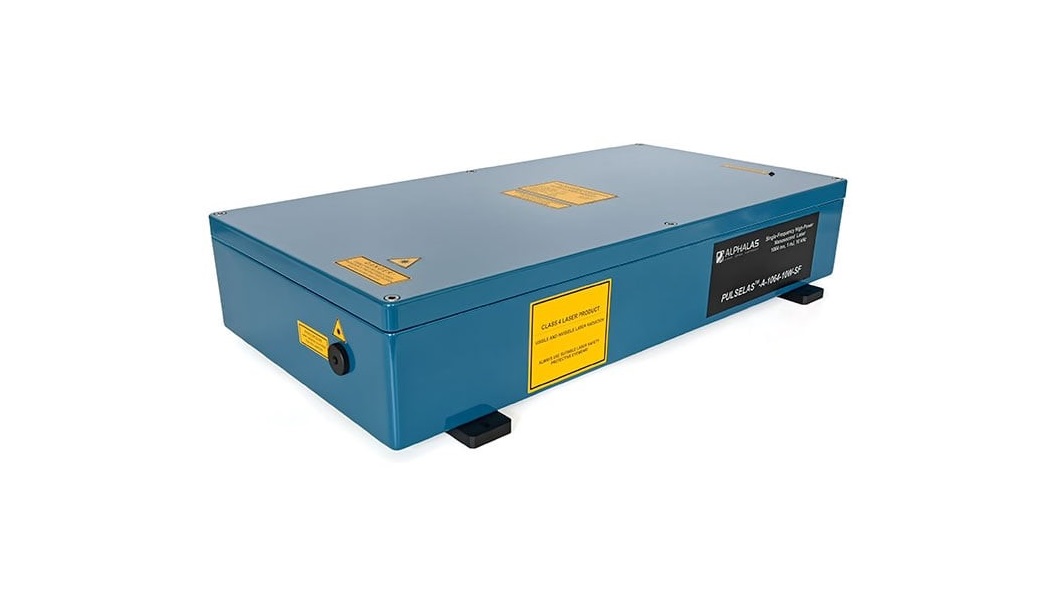


لیزر نانو ثانیه تک مد
nanosecond single mod laser
 In ultrafast optics, the transform limit (or Fourier limit, Fourier transform limit) is usually understood as the lower limit for the pulse duration which is possible for a given optical spectrum of a pulse. A pulse at this limit is called transform limited. The condition of being at the transform limit is essentially equivalent to the condition of a frequency-independent spectral phase (which leads to the maximum possible peak power), and basically implies that the time–bandwidth product is at its minimum and that there is no chirp. The minimum time–bandwidth product depends on the pulse shape, and is e.g. ≈ 0.315 for bandwidth-limited sech2-shaped pulses and ≈ 0.44 for Gaussian-shaped pulses. (These values hold when a full-width-at-half-maximum criterion is used for the temporal and spectral width.)
For a given pulse duration, transform-limited pulses are those with the minimum possible spectral width. This is important e.g. in optical fiber communications: A transmitter emitting close to transform-limited pulses can minimize the effect of chromatic dispersion during propagation in the transmission fiber, and thus maximize the possible transmission distance.
Many mode-locked lasers, particularly soliton mode-locked lasers, are able to generate close to transform-limited pulses. During propagation e.g. in transparent media, phenomena such as chromatic dispersion and optical nonlinearities can cause chirp and thus can lead to non-transform-limited pulses. Such pulses may be brought back to the transform limit (and thus temporally compressed) by modifying their spectral phase, e.g. by applying a proper amount of chromatic dispersion. This is called dispersion compensation. For not too broad spectra, compensation of second-order dispersion is often sufficient, whereas very broad spectra may require compensation also of higher-order dispersion to approach the transform limit.
?What is a transform-limited pulse
A transform-limited pulse is an optical pulse which has the shortest possible duration for its given optical spectrum. This occurs when the pulse has a frequency-independent spectral phase, which also results in the maximum possible peak power.
?What does the time-bandwidth product tell us about a pulse
The time–bandwidth product relates the temporal duration of a pulse to its spectral width. A pulse is at the transform limit when its time–bandwidth product is at the minimum possible value, which depends on the pulse shape (e.g., ≈0.315 for sech2 pulses).
?Why are transform-limited pulses important in fiber communications
In optical fiber communications, using pulses which are close to the transform limit minimizes their spectral width for a given duration. This reduces the pulse-broadening effects of chromatic dispersion in the fiber, thereby maximizing the possible transmission distance.
برگرفته از RP Photonics


